
Saint Patrick's Day 1864
Special Edition (March 17, 1864)

Throughout the southern states, Saint Patrick’s Day celebrations were muted or abandoned altogether, even in Savannah, Georgia, which had held massive parades since 1824. This would be the third Saint Patrick’s Day parade cancellation in the city’s history, the others being in 1824 and 1862. Traditional holiday parades and celebrations were held in many northern cities, including Philadelphia (PA), Boston (MA), and Chicago (IL). And Salt Lake City (UT) held its first annual Saint Patrick’s Day parade, which was organized by Irish immigrants working on the railroad and in local mines. The Irish Brigade, which was stationed at Stevensburg, Virginia, staged a ‘Grand Irish Steeplechase,’ but celebrations paled in comparison to the ones staged earlier in the war. This was mostly due to the heavy casualties incurred by the brigade and its ever thinning ranks.
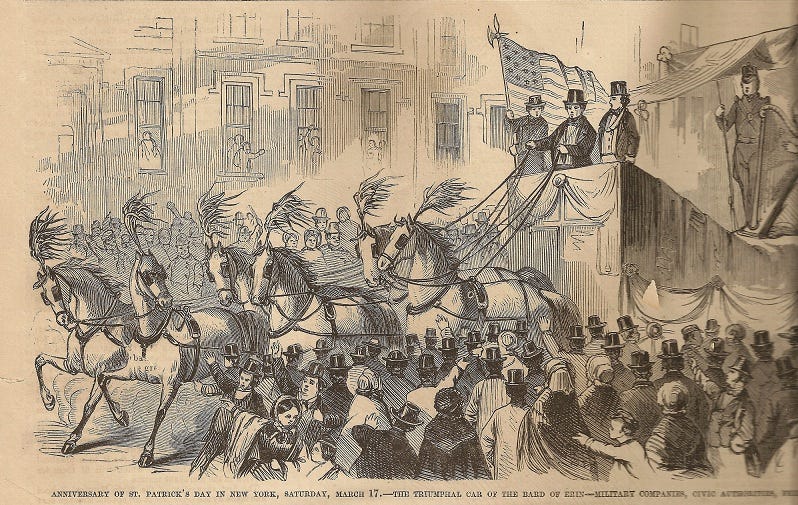
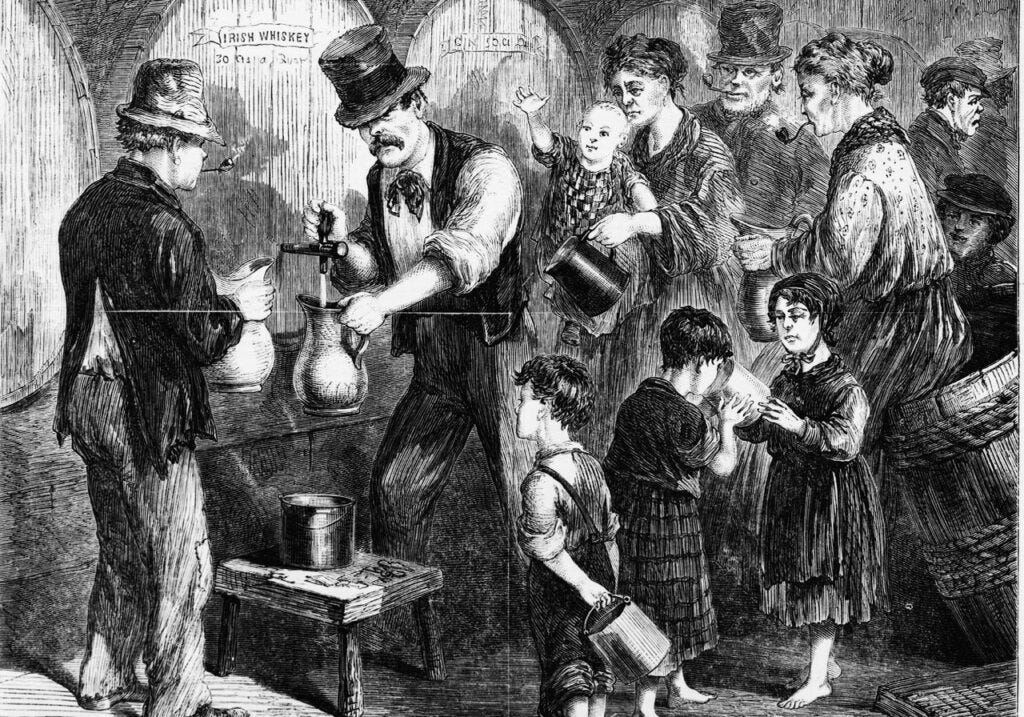
In New York City, the Ancient Order of Hibernians staged their largest parade to date, featuring organizations like the Fenian Brotherhood, the Hibernian Society, and the Laborers’ Protective Association. In a twist from modern celebrations, in 1864, the main focus of many of these groups was abstinence from alcohol.
From Irish in the American Civil War:
The morning of 17th March 1864 started out cloudy and overcast but the weather would clear up before noon. One reporter remarked that the streets were ‘wonderfully clean’ (before adding the caveat for New York streets). As was usual the celebrations began with mass. A solemn High Mass took place in St. Patrick’s Cathedral at 10.30, with Carl Maria Von Weber’s Mass in G being selected and sung by the Choirs of St. Patrick’s and St. Peter’s. The Reverend Francis T. Boyle announced from the pulpit that the day’s collection was to be given to the Conference of St. Vincent de Paul for the relief of the poor. He then gave his sermon, which covered much of the history of religion on the island of Ireland, before touching on more recent times:
“When famine came upon them [the Irish], if they were not a people of faith, they could never have upheld themselves in the hour of that dreadful calamity. Standing over the graves of their wives and children, their eyes streaming with tears, they still said, “The will of God be done;” they gave God the glory. In the land of the stranger they made monuments of the past which incited them to their duty in the present. The hardy pioneer of the West puts pictures of Christ and His Mother on the walls of his cabin, and tells their history on his humble beads.”
The procession itself included no fewer than 20,000 participants. Assembling on East Broadway around 11:00, the different groups began to arrange themselves into an order of march. Military contingents set out from their armories to the rendezvous. Some 600 men of the 69th New York were there, supported by 400 men of the 99th New York National Guard. The latter unit, which was led by Fenian John O’Mahony, had only received its colors the night before and had not yet been given uniforms. Other military contingents included men of the 1st New York National Guard Cavalry, the 70th New York National Guard, and the ‘Napper Tandy’ Light Artillery of Brooklyn. With everyone finally in some semblance of order, at 12.20 a signal gun was fired at the junction of East Broadway and Grand St. by command of Sergeant Major Mulqueen and men of the 4th Artillery. With that, the hordes of military and civic societies began their march. It would take them down East Broadway and Chatham Street to the City Hall Park and beyond.1
From: https://irishamericancivilwar.com/2014/03/17/flags-of-old-ireland-for-one-cent-and-alls-right-dads-sober-new-yorks-st-patricks-day-parade-1864/