
Love Conquers All
Special Edition (March 9, 1863)

On March 9, 1863, at 3:30 a.m., Lieutenant Lawrence L. O’Connor of the Provost-Marshal's Office, sent an urgent message from Fairfax Station, Virginia, reporting that Brigadier-General Edwin H. Stoughton, commander of the Second Vermont Brigade, had been captured in a surprise raid. He wrote, “Captain [John S. Mosby], with his command, entered this town this morning at 2 a.m…. They took Brigadier-General Stoughton and horses, and all his men detached from his brigade.” O’Connor immediately arrested nine male citizens of the town for ‘spying and disloyalty,’ and sent them to Old Capitol Prison in Washington City. O’Connor also explained that he had avoided capture because he was out “visiting outposts” at the time of the raid.
Mosby’s target for the raid was Union Colonel Percy Wyndham, a British soldier of fortune who commanded the First New Jersey Cavalry. Wyndham and Mosby had an ongoing personal feud. According to the New York Times, “Wyndham had incurred Mosby’s wrath by referring to his rangers as a ‘pack of horse thieves’ and threatening to burn Middleburg, alleged to be Mosby’s center of operations.” Wyndham’s headquarters was located in the house of Edward R. Ford, a prominent local merchant and ardent secessionist. When it was discovered that Wyndham was not present (he had been called to Washington City), Mosby entered the nearby home of Dr. William P. Gunnell and discovered the sleeping Stoughton. At the time, the twenty-four year old Stoughton was the youngest brigadier-general in the Union Army, and was awaiting official confirmation of his appointment by the U.S. Senate. Although Edward Ford was one of the men arrested after the raid, suspicion soon fell on his daughter Antonia J. Ford, who was thought to be a Confederate spy.
Within days of the raid, Lafayette C. Baker, head of the U.S. Secret Service, focused his attention on Antonia. According to his investigation, “Stoughton’s mother, his sister, and three of his aides had stayed in Ford’s home” for a party on March 8th, causing security to become lax. In addition, an anonymous letter accused Stoughton and Antonia of having been “very intimate.” (This was almost certainly false.) Baker sent a young female undercover agent to Fairfax Station to investigate, using the cover story that she was a Mississippi belle stranded behind Union lines. During her stay of several days, she and Antonia talked for hours and in the course of their conversations, Antonia revealed that she had been given a commission as an “honorary aide-de-camp” from Confederate cavalry commander J.E.B. Stuart.
Antonia Ford’s connection to J.E.B. Stuart began in the Fall of 1861, after Union troops had occupied the Ford home. Antonia was able to overhear private conversations and reported what she could to Stuart’s headquarters in nearby Fairfax Court-House. (Antonia’s brother was serving in Stuart’s cavalry.) By the fall of 1862, the Ford home had become a boarding house for Union officers, providing an ideal setting for procuring valuable information. After Antonia learned of the Union attack plans prior to the Second Bull Run battle, she rode twenty miles in the rain to Stuart’s camp to warn them.
Stuart’s Honorary Commission:
TO WHOM IT MAY CONCERN:
Know ye: That reposing Special Confidence in the Patriotism, fidelity and ability of Miss Antonia Ford, I, James E.B. Stuart, by virtue of the power vested in me, as Brigadier General in the Provisional Army of the Confederate States of America, do hereby appoint and commission her my Honorary aide-de-camp, to rank as such from this date. She will be obeyed, respected and admired by all lovers of a noble nature.
Given under my hand and seal at the headquarters, Cavalry Brigade, at Camp Beverly, this seventh day of October, A.D., 1861, and the first year of our Independence.
James E.B. Stuart, Brigadier General, C.S.A.
Shortly after the undercover agent’s departure, Secret Service agents appeared at the Ford residence and asked Antonia to take the Union loyalty oath. When she refused, the agents searched the house, “finding letters from Union officers, along with $6,000 in C.S. money and Stuart’s commission.” With a link established between Antonia and J.E.B. Stuart, she was arrested and charged with aiding and abetting the capture of General Stoughton and brought to Old Capitol Prison. Despite her continued determination not to sign the Union loyalty oath, Antonia was released as part of a prisoner exchange and allowed to return home. However, she and her father were arrested within days of her return for again refusing to take the oath and she was returned to Old Capitol Prison.
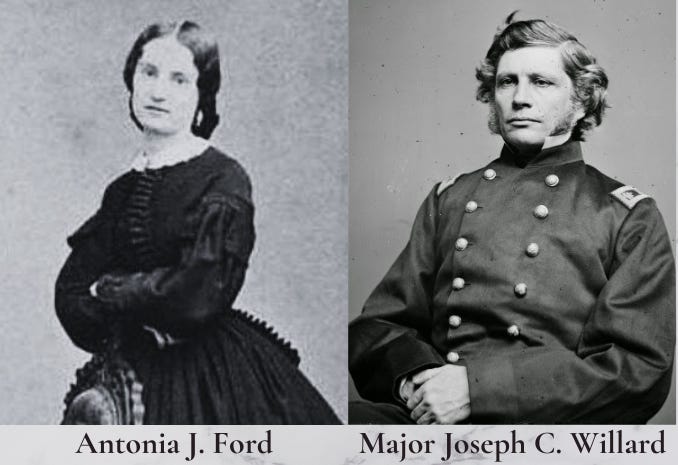
While she was a prisoner, Antonia met and became friends with Union Major Joseph C. Willard, a part owner of the famous Willard Hotel, who was serving on the staff of the prison provost-marshal. The two had met previously when Willard was serving on the staff of Irvin McDowell and, despite their disparate backgrounds, a romance blossomed. Upon her return to prison, which had rendered her “frail and sickly,” she agreed to take the loyalty oath if he would resign his commission. He agreed, and on September 18, 1863 Antonia and her father swore allegiance to the Union and were freed.
Although she was now free from prison, Antonia still had a few more knots to untangle. In addition to their age difference of twenty years, the Vermont-born Willard was also currently married and the process for his divorce could take months. Antonia also had to break the news to her pro-secession family that she was betrothed to a Yankee. Willard intended to divorce his wife, whom he had married in 1849, but the only grounds available under federal law in Washington City were adultery, bigamy, lunacy, or impotence. Willard chose lunacy, but before he could file the legal papers, his wife filed for divorce against him on the grounds of adultery. She alleged that he had relations with women of “damaged reputations” at the Willard Hotel and with a woman named Caroline Rosekrans in the Willards' own home. Major Willard did not contest the charges.
Major Willard resigned his commission on March 1, 1864, his divorce was granted the day after, and they were married at the New York Avenue Presbyterian Church on March 10th. The two settled in Washington City and had three children, only one of whom survived infancy. Through inheritance and investments, their son Joseph E. Willard became the wealthiest man in Virginia. He also served as a member of the Virginia House of Delegates, lieutenant-governor of Virginia, and was the U.S. ambassador to Spain. He even enjoyed a brief military career, serving on the staff of Fitz. Lee during the Spanish-American War. His daughter, Belle Wyatt Willard, married Kermit Roosevelt, the son of Theodore Roosevelt, in 1914.
The question of whether or not Antonia spied for John S. Mosby prior to the Fairfax Station raid has never been settled conclusively. Despite her avowed allegiance to the Confederacy, she always denied providing information to Mosby. A year before his death in 1868, Stoughton wrote to Mosby seeking to repair his damaged reputation and asking that he disavow any involvement by Antonia in the raid. Mosby complied, and in another letter written to one of his friends in 1900, Mosby stated that Antonia was “as innocent as Abraham Lincoln.” Despite Mosby’s denial, it seems likely that Antonia was involved to some degree in the planning of the raid.
