From the Editor: Playing the Game of Bumblepuppy
Week 177: May 15 to May 21 1864

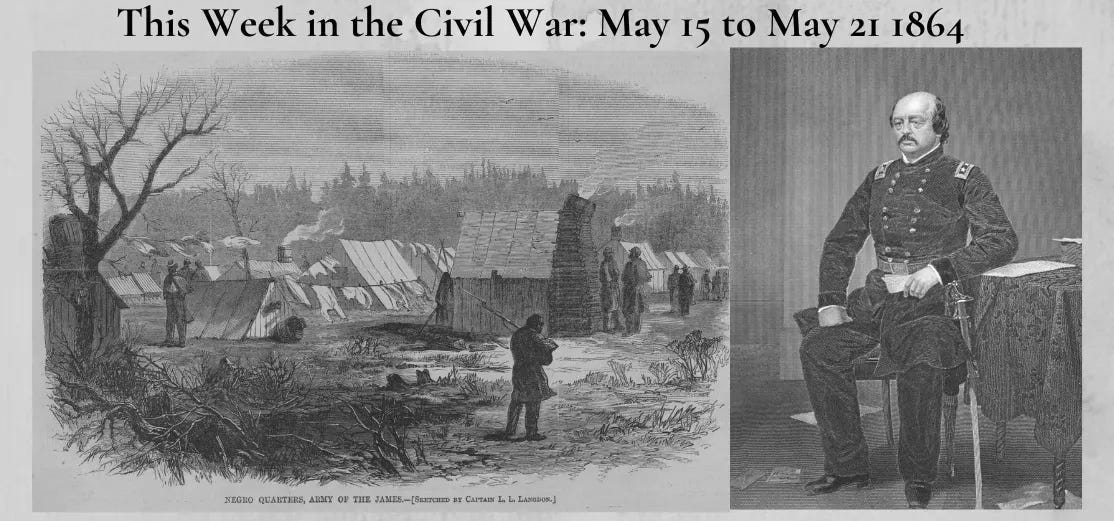
From the Editor: The sad saga of defeat which surrounded the Army of the James has overshadowed its very real opportunity to strike a defining blow during the Civil War. Led by Ben Butler, the only politician to command more than a single army corps and featuring the largest percentage of black troops among all the Union armies, this army lost virtually every campaign, battle, and engagement it fought. Butler absorbed much of the blame for this litany of defeat, but was not helped by the fact that seventy percent of his generals were fellow non-West Pointers. U.S. Grant attempted to ameliorate this situation by assigning Quincy Gillmore and William ‘Baldy’ Smith to command the two corps of this army. This was an unfortunate miscalculation on Grant’s part. After Gillmore's stunning capture of Fort Pulaski in April 1862, he was completely stymied by the Confederate defenses in Charleston harbor. According to Butler, "General Gillmore may be a very good engineer officer, but he is wholly useless in the movement of troops." Baldy Smith's reputation was equally tenuous. Even though he earned Grant's respect with his good work at Chattanooga, Grant was wary of Smith's inability to serve as loyal subordinate. He observed: "General Smith, whilst a very able officer, is obstinate, and is likely to condemn whatever is not suggested by himself."
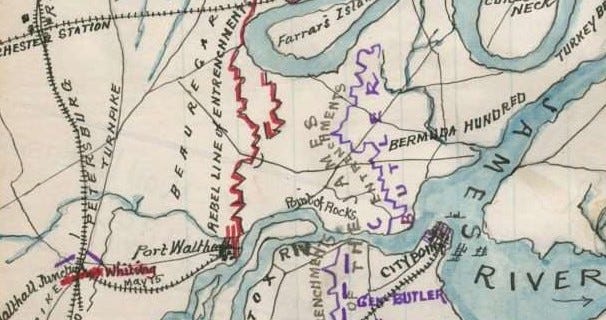
The inability of Generals Butler, Gillmore, and Smith to work together doomed the effectiveness of this army. In their initial advance towards Petersburg, only Colonel Robert Graham’s 600-man command, the 21st and 25th South Carolina, stood in their way. However, in less than two weeks G.T. Beauregard would arrive along with almost 30,000 troops. During the period before Beauregard’s arrival, Butler had ample time and resources to strike at either Petersburg or Richmond but succeeded only in constructing a line of fortifications to protect his position at Bermuda Hundred. According to Baldy Smith, “The movement of the forces under Butler was close to the boundary line between the true art of war and the game of *bumblepuppy.” Concerned with Butler’s situation, Grant sent Quartermaster-General Montgomery Meigs and Chief Engineer John G. Barnard to Bermuda Hundred to inspect “what is being done,” and determine what “it is advisable to do.” It was General Barnard who came up with the best description of the predicament of the Butler’s Army of the James: “It’s like a bottle, General, but the enemy has corked it!”2
Editor’s Note: Bumblepuppy refers to a manner of playing whist “either in utter ignorance of all its known principles, or in defiance of them, or both.”3

To read the entire post, check out: